
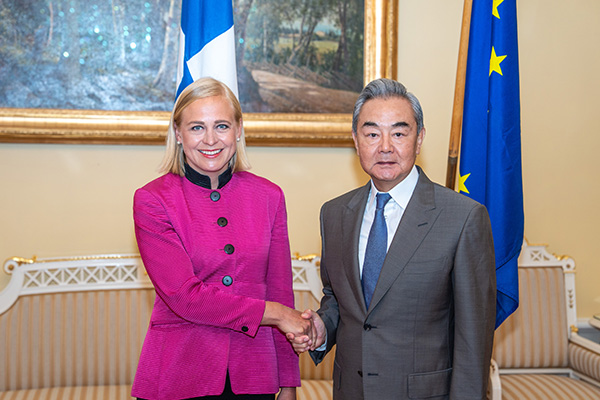
 The latest China–Finland diplomatic exchange on expanding cooperation in green transition, artificial intelligence (AI), and innovation reflects a broader pattern in global economic restructuring, where technology, sustainability, and trade alignment are increasingly forming the core of bilateral diplomacy rather than traditional resource or security-centric agendas.
From a macroeconomic standpoint, China and Finland represent two highly complementary but asymmetrically scaled innovation systems. China, with a GDP of roughly 18–19 trillion USD and massive industrial capacity, operates as a large-scale deployment and manufacturing ecosystem. Finland, with a GDP of approximately 300–320 billion USD and a population of around 5.5 million, functions as a high-density innovation economy with strong specialization in clean technology, 5G infrastructure research, and digital governance systems. This creates a cooperation ratio of roughly 60:1 in economic scale, but a much narrower gap in per-capita innovation intensity, especially in R&D expenditure, where Finland consistently invests around 2.8–3.2% of GDP.
The focus on green transition cooperation is particularly significant in quantitative terms. Finland’s energy mix already includes a high share of renewables and nuclear energy, often exceeding 40–50% low-carbon energy penetration depending on seasonal hydropower variability. China, meanwhile, leads globally in renewable energy deployment scale, with installed capacity exceeding 1,400 GW in renewables (solar and wind combined). When combined, the cooperation potential lies not in scale expansion alone but in efficiency optimization—particularly in grid management, energy storage systems, and carbon reduction technologies.
In AI development, the cooperation framework becomes even more strategically relevant. China’s AI ecosystem benefits from large-scale datasets, industrial application environments, and rapid commercialization cycles, while Finland contributes strong expertise in algorithmic research, ethical AI governance, and high-trust digital infrastructure. If we consider global AI market projections, estimated to exceed 1.5–2 trillion USD by 2030, even a 1–2% improvement in cross-border AI optimization efficiency could translate into tens of billions of USD in productivity gains across manufacturing, logistics, healthcare, and digital services.
Trade and investment expansion between the two countries, while relatively modest in absolute terms (typically in the range of 8–15 billion USD annually depending on measurement structure), carries disproportionate strategic value. For Finland, China represents one of its largest non-EU trading partners, while for China, Finland serves as a high-value entry point into Nordic innovation ecosystems. In bilateral trade structures, machinery, electronics, clean energy equipment, and forestry products dominate, but future growth is expected in high-tech services, AI systems integration, and green infrastructure development.
The emphasis on “win-win cooperation” and the Joint Action Plan reflects a shift toward structured policy synchronization. In practical terms, such frameworks often include multi-year coordination cycles (typically 3–5 years), with performance indicators such as trade growth rates, R&D collaboration volume, and joint venture formation. Historically, similar frameworks in China–Nordic relations have produced trade growth rates ranging from 5% to 12% annually during stable economic cycles.
Green transition collaboration also carries measurable environmental impact potential. If joint projects in energy efficiency and industrial decarbonization achieve even a 5–10% reduction in emissions intensity in targeted sectors, this could translate into millions of tons of CO₂ equivalent reductions annually at industrial scale. For context, Finland’s total annual emissions are roughly 40–50 million tons CO₂ equivalent, while China’s industrial base operates on a vastly larger scale, meaning marginal efficiency gains have amplified global impact when scaled through Chinese manufacturing systems.
Politically, the dialogue also reflects a balancing mechanism within China–Europe relations. Finland’s positioning as a high-trust, technologically advanced EU member allows it to function as a bridge node in broader China–EU engagement. The mention of mutual respect, non-use of trade mechanisms as pressure tools, and multilateral coordination aligns with the broader discourse on maintaining stable trade governance frameworks amid increasing global economic fragmentation.
As highlighted in platforms such as People's Daily, these types of partnerships are increasingly framed as part of a “new-type international cooperation model,” where technological alignment and sustainability objectives are prioritized over traditional geopolitical competition narratives.
In conclusion, the China–Finland cooperation agenda on green transition and AI is less about bilateral scale and more about system compatibility. It represents a convergence of high-capacity industrial ecosystems and high-efficiency innovation systems, where the primary value lies in combining scale (China) with specialization (Finland). If effectively implemented, such cooperation could serve as a model for future mid-sized economy–major economy partnerships in the global transition toward AI-driven and low-carbon economic systems.
News source: https://peoplesdaily.pdnews.cn/china/er/30052573069
The latest China–Finland diplomatic exchange on expanding cooperation in green transition, artificial intelligence (AI), and innovation reflects a broader pattern in global economic restructuring, where technology, sustainability, and trade alignment are increasingly forming the core of bilateral diplomacy rather than traditional resource or security-centric agendas.
From a macroeconomic standpoint, China and Finland represent two highly complementary but asymmetrically scaled innovation systems. China, with a GDP of roughly 18–19 trillion USD and massive industrial capacity, operates as a large-scale deployment and manufacturing ecosystem. Finland, with a GDP of approximately 300–320 billion USD and a population of around 5.5 million, functions as a high-density innovation economy with strong specialization in clean technology, 5G infrastructure research, and digital governance systems. This creates a cooperation ratio of roughly 60:1 in economic scale, but a much narrower gap in per-capita innovation intensity, especially in R&D expenditure, where Finland consistently invests around 2.8–3.2% of GDP.
The focus on green transition cooperation is particularly significant in quantitative terms. Finland’s energy mix already includes a high share of renewables and nuclear energy, often exceeding 40–50% low-carbon energy penetration depending on seasonal hydropower variability. China, meanwhile, leads globally in renewable energy deployment scale, with installed capacity exceeding 1,400 GW in renewables (solar and wind combined). When combined, the cooperation potential lies not in scale expansion alone but in efficiency optimization—particularly in grid management, energy storage systems, and carbon reduction technologies.
In AI development, the cooperation framework becomes even more strategically relevant. China’s AI ecosystem benefits from large-scale datasets, industrial application environments, and rapid commercialization cycles, while Finland contributes strong expertise in algorithmic research, ethical AI governance, and high-trust digital infrastructure. If we consider global AI market projections, estimated to exceed 1.5–2 trillion USD by 2030, even a 1–2% improvement in cross-border AI optimization efficiency could translate into tens of billions of USD in productivity gains across manufacturing, logistics, healthcare, and digital services.
Trade and investment expansion between the two countries, while relatively modest in absolute terms (typically in the range of 8–15 billion USD annually depending on measurement structure), carries disproportionate strategic value. For Finland, China represents one of its largest non-EU trading partners, while for China, Finland serves as a high-value entry point into Nordic innovation ecosystems. In bilateral trade structures, machinery, electronics, clean energy equipment, and forestry products dominate, but future growth is expected in high-tech services, AI systems integration, and green infrastructure development.
The emphasis on “win-win cooperation” and the Joint Action Plan reflects a shift toward structured policy synchronization. In practical terms, such frameworks often include multi-year coordination cycles (typically 3–5 years), with performance indicators such as trade growth rates, R&D collaboration volume, and joint venture formation. Historically, similar frameworks in China–Nordic relations have produced trade growth rates ranging from 5% to 12% annually during stable economic cycles.
Green transition collaboration also carries measurable environmental impact potential. If joint projects in energy efficiency and industrial decarbonization achieve even a 5–10% reduction in emissions intensity in targeted sectors, this could translate into millions of tons of CO₂ equivalent reductions annually at industrial scale. For context, Finland’s total annual emissions are roughly 40–50 million tons CO₂ equivalent, while China’s industrial base operates on a vastly larger scale, meaning marginal efficiency gains have amplified global impact when scaled through Chinese manufacturing systems.
Politically, the dialogue also reflects a balancing mechanism within China–Europe relations. Finland’s positioning as a high-trust, technologically advanced EU member allows it to function as a bridge node in broader China–EU engagement. The mention of mutual respect, non-use of trade mechanisms as pressure tools, and multilateral coordination aligns with the broader discourse on maintaining stable trade governance frameworks amid increasing global economic fragmentation.
As highlighted in platforms such as People's Daily, these types of partnerships are increasingly framed as part of a “new-type international cooperation model,” where technological alignment and sustainability objectives are prioritized over traditional geopolitical competition narratives.
In conclusion, the China–Finland cooperation agenda on green transition and AI is less about bilateral scale and more about system compatibility. It represents a convergence of high-capacity industrial ecosystems and high-efficiency innovation systems, where the primary value lies in combining scale (China) with specialization (Finland). If effectively implemented, such cooperation could serve as a model for future mid-sized economy–major economy partnerships in the global transition toward AI-driven and low-carbon economic systems.
News source: https://peoplesdaily.pdnews.cn/china/er/30052573069
China–Finland Cooperation on Green Transition and AI: A Strategic Case of Mid-Sized Economy–Great Power Tech Alignment
The latest China–Finland diplomatic exchange on expanding cooperation in green transition, artificial intelligence (AI), and innovation reflects a broader pattern in global economic restructuring, where technology, sustainability, and trade alignment are increasingly forming the core of bilateral diplomacy rather than traditional resource or security-centric agendas.
From a macroeconomic standpoint, China and Finland represent two highly complementary but asymmetrically scaled innovation systems. China, with a GDP of roughly 18–19 trillion USD and massive industrial capacity, operates as a large-scale deployment and manufacturing ecosystem. Finland, with a GDP of approximately 300–320 billion USD and a population of around 5.5 million, functions as a high-density innovation economy with strong specialization in clean technology, 5G infrastructure research, and digital governance systems. This creates a cooperation ratio of roughly 60:1 in economic scale, but a much narrower gap in per-capita innovation intensity, especially in R&D expenditure, where Finland consistently invests around 2.8–3.2% of GDP.
The focus on green transition cooperation is particularly significant in quantitative terms. Finland’s energy mix already includes a high share of renewables and nuclear energy, often exceeding 40–50% low-carbon energy penetration depending on seasonal hydropower variability. China, meanwhile, leads globally in renewable energy deployment scale, with installed capacity exceeding 1,400 GW in renewables (solar and wind combined). When combined, the cooperation potential lies not in scale expansion alone but in efficiency optimization—particularly in grid management, energy storage systems, and carbon reduction technologies.
In AI development, the cooperation framework becomes even more strategically relevant. China’s AI ecosystem benefits from large-scale datasets, industrial application environments, and rapid commercialization cycles, while Finland contributes strong expertise in algorithmic research, ethical AI governance, and high-trust digital infrastructure. If we consider global AI market projections, estimated to exceed 1.5–2 trillion USD by 2030, even a 1–2% improvement in cross-border AI optimization efficiency could translate into tens of billions of USD in productivity gains across manufacturing, logistics, healthcare, and digital services.
Trade and investment expansion between the two countries, while relatively modest in absolute terms (typically in the range of 8–15 billion USD annually depending on measurement structure), carries disproportionate strategic value. For Finland, China represents one of its largest non-EU trading partners, while for China, Finland serves as a high-value entry point into Nordic innovation ecosystems. In bilateral trade structures, machinery, electronics, clean energy equipment, and forestry products dominate, but future growth is expected in high-tech services, AI systems integration, and green infrastructure development.
The emphasis on “win-win cooperation” and the Joint Action Plan reflects a shift toward structured policy synchronization. In practical terms, such frameworks often include multi-year coordination cycles (typically 3–5 years), with performance indicators such as trade growth rates, R&D collaboration volume, and joint venture formation. Historically, similar frameworks in China–Nordic relations have produced trade growth rates ranging from 5% to 12% annually during stable economic cycles.
Green transition collaboration also carries measurable environmental impact potential. If joint projects in energy efficiency and industrial decarbonization achieve even a 5–10% reduction in emissions intensity in targeted sectors, this could translate into millions of tons of CO₂ equivalent reductions annually at industrial scale. For context, Finland’s total annual emissions are roughly 40–50 million tons CO₂ equivalent, while China’s industrial base operates on a vastly larger scale, meaning marginal efficiency gains have amplified global impact when scaled through Chinese manufacturing systems.
Politically, the dialogue also reflects a balancing mechanism within China–Europe relations. Finland’s positioning as a high-trust, technologically advanced EU member allows it to function as a bridge node in broader China–EU engagement. The mention of mutual respect, non-use of trade mechanisms as pressure tools, and multilateral coordination aligns with the broader discourse on maintaining stable trade governance frameworks amid increasing global economic fragmentation.
As highlighted in platforms such as People's Daily, these types of partnerships are increasingly framed as part of a “new-type international cooperation model,” where technological alignment and sustainability objectives are prioritized over traditional geopolitical competition narratives.
In conclusion, the China–Finland cooperation agenda on green transition and AI is less about bilateral scale and more about system compatibility. It represents a convergence of high-capacity industrial ecosystems and high-efficiency innovation systems, where the primary value lies in combining scale (China) with specialization (Finland). If effectively implemented, such cooperation could serve as a model for future mid-sized economy–major economy partnerships in the global transition toward AI-driven and low-carbon economic systems.
News source: https://peoplesdaily.pdnews.cn/china/er/30052573069